Thursday, April 30, 2009

Why I Did Not Vote

I went to the booth and came back. The following is my tryst with voting.

Today was voting day in my constituency. Along with the elderly, who were still yearning for a good debate between capitalism and Marxism between themselves at the booth, a significant chunk of people at the booth were people in the 25-30 age group.

The election euphoria has been sustained for a long time before it reaches its end (in my city at least!) today. The first major sign of this was with the Lead India campaign last year. I was working with Times of India at this point and extensively covered the shoot of the series from the Film city sets. At that point too, there was no real sense of urgency to tackle the political scene with individuals and qualified people. The contestants were more interested in garnering votes from the public like true politicians with a hint of rhetoric and self righteous indignation on various topics which did not affect their lives directly—from Emergency, to Bangladesh, to defence budgets to Medha Patkar. That show showed me how even qualified and professional people would also stoop to the level of a politician to win, when in fact the show was all about changing the way the country looked at politicians. Everyone, however, agreed that the show was a great concept was very much needed in today’s times.

The real bombardment began in earnest with the Jaago Re campaign. The average normal Indian was progressively cajoled, exhorted and finally threatened to vote for the current general elections happening across the country.  The media, in the aftermath of 26/11 also picked up on the Vote India campaign. But seriously, is voting worth it?

The way I see it, voting can only change if the voting list itself is up to the standard. Now, I set my standard for my politician to be quite high. I want him/ her to be known (like Milind Deora), to be seen doing some work (like Priya Dutt), to be relatively corruption free, be a true secularist, be accessible, be sensible and someone who comes across as a person with a plan (no names comes to mind).

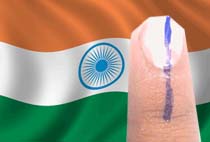
Let me illustrate with my experience. At the polling booth, a friend came out and showed me the finger, with the election mark. I asked him whom he voted for, and he said Congress. Why? “Because I want Rahul Gandhi to be PM.” This first-time voter did not even know the candidate he was voting for. He simply clicked the name next to the Congress hand and came back happy, as if he’d braved an Arctic storm.

On my way back another acquaintance told me he was going to vote — for the BJP. Why, I asked, mildly curious. “Ram Naik was so much better than Govinda,” he said. This fellow has not even heard of demilitation and did not even know the candidate who were standing for election from my constituency. In essence, my area has been clubbed with an area which mainly comprises of tribal area. The candidates were all new faces and new names, people I knew nothing about. It did not make sense to vote for them.

On my visit to Vidarbha in March, I was at Lonar (the one with the famous crater) on the day of the election. The state transport bus was unusually full with voters going about casting their vote and I began small talk. I found an entire family of 14 who were returning without casting their vote because someone had already done their job for them. The family did not seem surprised or outraged. It is a story repeated in villages across the country. I know this is how the Left managed to stay in office for over 25 years in West Bengal. So, paradoxically, the electors elect themselves and the role of people is left to doing nothing. This is not an election formed by democratic consent, but more of pseudo autocrats created by power-hungry marauders.

As I see it then, this election is hardly different than any other. The trains were empty, the media was present in full force near ISKCON temple at Juhu, waiting for a celebrity to come down and cast their vote than talk to the people who had braved the heat to cast their vote, the same set of politicians are contesting the polls (none of whom would have been sensitized to the needs of people they seek to represent) and finally, the outcome will be decided by a set of murderers and looters who will find more ways of pillage and plunder. I, for one, do not wish to be associated with a government as this.

You may call it impractical and cynical, but I believe an informed, aware and better set of politicians is still at least a decade away (and I’m trying to be very optimistic here). Until then, it’s better to sleep in slight discomfort caused by others than stay awake in mayhem created by your own doing.


Monday, April 20, 2009

What does money mean to you?


The New York Times has come out with an interesting weekend competition. It requires people to define 'money'. Money, that generic dirty word that like friction, we cannot do without and which is the cause of so many squabbles the world over. My definition? A form of barter that leaves the rich richer and the poor poorer after every transaction. Do you have any definition? Post it here or apply on NYT here.

Saturday, December 20, 2008

It wasn’t just about the Fab Four


Hoardings put up by opportunistic political parties across Mumbai carry messages of solidarity along with pictures of Hemant Karkare, Vijay Salaskar, Ashok Kamte and Sandeep Unnikrishnan. They have now become part of legend, brave heroes of 26/11; in a grotesquely macabre and ironical way; the face of the attack; apart from pictures of captured terrorist Ajmal Amir Kasab of course.
In the meanwhile, policemen who tried to defend the Taj with their World War 2 rifles, a 54-year-old policeman with a family who took bullets from Kasab so he could be captured alive at Girgaum Chowpatty, the Bihari policeman who risked life (and limb) to foil Kasab and his associate’s plan of taking over CST terminus have largely been forgotten. Everybody who fought the terror attack and lost their life, died for a cause. It would to foolish to call it martyrdom. This was a attack and our fallen heroes were all serving to defend the country and its terrified people from the idea of democracy and right to life. That the democracy had given them ill-equipped resources to defend itself is the greatest travesty and their ultimate deaths, a victim of circumstance.
I however feel that we have become obsessed of finding heroes to reassure ourselves that good people exist out there. This is partly because no political leadership was forthcoming during and after the attacks but we are being vainglorious if we believe that it is only the efforts of these Fab Four that saved Mumbai.
On my rounds to various hospitals across the city in the immediate aftermath of the attack, I found so many stories of bravery and heroism that I somehow felt these stories were getting dwarfed because the heroes themselves never thought about their selfless acts of saving lives.
Let me give you a few examples. A headwaiter took most of the guests from Tiffin restaurant at Oberoi to safely putting himself in the line of fire. Small time people like chaiwalas and clothiers were busy providing water and biscuits to the MARCOS and NSG commandos near Taj and Nariman House with grenades and bullets ricocheting a few feet from them.
I only wish we acknowledge the contributions of the entire city and salute this spirit of humanity that survived the 60-hour ordeal the city bore so tortuously. Saving a life is the most supreme act of compassion human beings can display. Does it bother you then that we give all the success only to four men on duty rather than all the others who took it upon themselves to perform this act of compassion purely as duty to humanity?

Wednesday, July 23, 2008

Batman and his dark (k)nights


I have been reading how the new Batman movie - a sequel to Batman Begins by director Chirstopher Nolan - has been breaking box office records by the day. My interest in this whole venture was piqued after I chanced upon a group of Dark Knight fans and their keen interest in the movie, its characters and of course Heath Ledger, who plays the role of Joker almost to perfection.

I saw the movie yesterday with a smattering of college going adults and a few oldies for the 152 minute adventure. The movie, per se, is well made and all actors - from Micheal Caine to Gary Oldman to Morgan Freeman - play their parts well. The important actors do their job well too.

What I liked most about the flick (apart from the absence of Robin!) was the transformation of Harvey Dent (Aaron Eckhart) to Two-face. It was a great move showing his wicked side after trying to be the saviour of the fictional Gotham City - in this case a NYC clone full of highrises and Gotham Police Dept cars and a jetty for the climax. The two sides of good and evil signifies how easy it is to manipulate even the best of minds into taking up the wrong road. It somehow enhances the human tug-of-war Bruce Wayne faces each time he tries to stop crime.

Another cool character was Joker. Although he didnt hold my attention towards the climax (which I found a bit convulated) he was thoroughly menacing and a delight to watch. I wonder what really Jack Nicholson must have told him before Ledger took up the role of Joker. Either way, I'll be highly disappointed if he doesnt at least get an Oscar nomination for this role.

This is the first movie in recent years to have got a 4-star rating from most reviews and so the anticipation of a great flick was so highly built up that I can forgive Nolan if I didnt find the movie to live up to that much hype. The flick is good yes, but not great. Batman has returned as a formidable superhero once again, but the film dragged in some parts and the climax, as I've said, could have been better. Great SFX work, but please get Bale to act a little more next time around.

I am not a big fan of comics. I was one of those who wanted to grow up too soon too quickly and abandoning comics for the mystery world of Hardy Boys in school before finally beginning a journey into the worlds of Sidney Sheldon, Jeffrey Archer, Ayn Rand, and others. Comics thus have sustained in me only through movies and the occasional write-ups. The group I met were fanatical about Batman which was a great thing for me since I can never match any of my readings with a fanbase except for Potter and maybe LOTR. I wonder if our connect to books is only because of our own experiences or because we like to escape into a fictional world to leave our worries behind.

Comics certainly suggest that we like to give wings to our imaginations and dreams and so will always be popular. And going by the hordes of people I've seen flocking to the theatres for the Dark Knight, I'm sure there'll be no one who will disagree with me.

If you've seen the movie, drop me a line on how you felt about it.

Monday, June 02, 2008

One year at TOI

On 4th June 2008 I will complete a career milestone. It will be one year since I would've first walked into the historic Times of India building at Bori Bunder. It is an organisation every student when learning journalism scoffs at and then itches to join. I was one among them.

The job (feature writer) at TOI is my third job having previously worked with an online data company called Baseline Studiosystems for Hollywood and then for DNA where I was shifted around departments more regularly than Paris Hilton makes news. The jobs lasted sixs months each and I was reveling in the fact that I could not be tied down by any organisation. That could only mean more experience with more organisations. But on the very first day of joining I promised myself I would at least last two years at TOI. Because ultimately I fell in the rat race of cleaning up my CV for my future employers who could not look upon my work experience and think of me as a dandy happy-go-lucky twenty-something bloke, which of course I am.
And herein lies my grouse. My work ethic counts for naught before the number of months (and now years) I give to a job. Why should a job be measured by time rather than passion and commitment. I have hardly had any substantial increments in my job-hopping spree. My salary has increased by 5K over these 3 jobs, and my sister, who worked for a call centre earned double of what I got last month. Clearly then, I am not in this field for the money. What I want is enough contancts and goodwill to last me even when I am not actively a part of this great media circus in India.
I will admit one year at TOI has been great. My friendship with a few celebrities has gone beyond the professional distinction of journalist and star, I have met a lot of journalists and am part of a very cool team of people, spoken to musical biggies like Klaus, Rudolph from the Scorpions, 50 Cent, Beyonce, America, Iron Maiden apart from other indi-bands and singers, I have hopped on Jet Airways to Bhopal twice to do some unusual stories and met a lot of people from the poor, tribal and neglected part of the city as well. I have also seen enough of journalism to know that it's a field where the demands and pressure of the job tend to make one cynical and superficial to society after a point in time at the sheer madness of it all. But if there's anything I fear losing more than my writing, it's my sense of humanism so yes, journalism is not a life-long career option, fun though it may be at this stage.
It has been a year rich in experience and the following year can only be better. Will it be at TOI or no is the question to answer though. Because I still have that individualistic streak of creating something unique and different and everyday the urge to write something - a script or a novel - gets bigger. I dont know how long I can ignore it. But it's not possible to do this while working and that is the biggest dilemma. Do I stake everything and run away to do a writing course abroad as I have been dreaming ever since graduating or do I sit and let time take its own course? I dont know and I'll be damned if God can help me.
Amen.